UNC Chip VR Experience

Overview
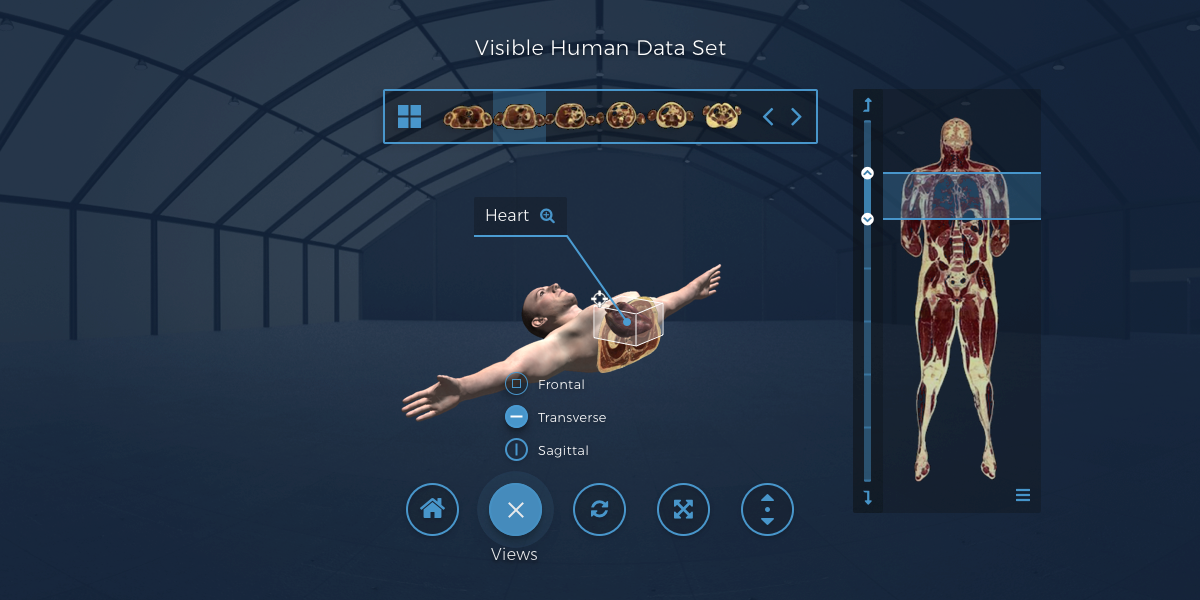
The Carolina Health Informatics Program (CHIP) Visible Human Project was an educational virtual reality experience designed to help students explore detailed cross-sectional data sets of the human body through immersive 3D visualization. Built for the Oculus Rift, the experience enabled users to interact with layered anatomical models, internal organs, and human body slices in an engaging and educational environment.
As the UI & UX Designer on the project, I focused on creating an intuitive VR experience that made complex medical information more accessible for students with little to no prior experience using virtual reality technology.


The Challenge
One of the primary challenges was designing for users who were unfamiliar with VR systems and controller interactions. Many students had limited technical experience, making usability and ease of navigation critical to the overall learning experience.
In addition, the complexity and volume of anatomical data presented a significant information architecture challenge. The experience needed to simplify interactions and reduce cognitive overload while still allowing students to meaningfully explore highly detailed human anatomy data sets.
The Goal
The objective was to create an engaging and approachable educational VR experience that would allow students to:
- Explore detailed anatomical structures in 3D
- Interact with layered human body visualizations
- Navigate complex medical information intuitively
- Learn through immersive and accessible interactions
A key priority was minimizing friction within the VR experience so users could focus on learning rather than struggling with controls or navigation.
My Role
UI & UX Designer
I was responsible for designing the end-to-end user experience for the VR application, including:
- User flows and interaction mapping
- VR controller interaction design
- Wireframing and interface design
- Prototyping and usability testing
- Visual design and asset creation
- Collaboration with developers to support implementation
Throughout the project, I worked closely with the development team to ensure the experience remained intuitive, immersive, and technically feasible within the VR environment.
Process & Collaboration
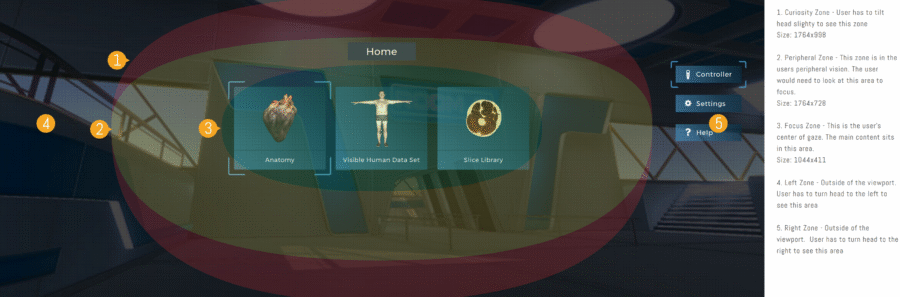
To better understand VR usability patterns and interaction behaviors, I conducted research into emerging virtual reality design methods and Oculus Rift interaction standards. Using those insights, I mapped user flows and simplified controller interactions to reduce complexity for first-time VR users.
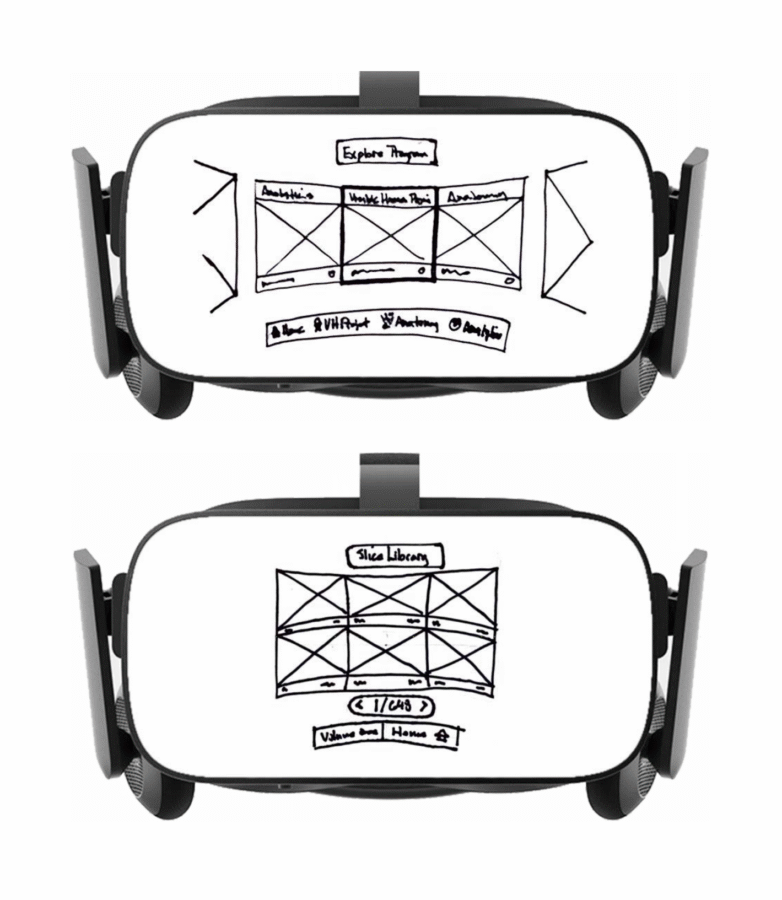
After establishing the interaction framework, I created wireframes and interactive prototypes to validate navigation patterns and usability concepts through iterative testing. Feedback from testing sessions informed multiple refinements to both interface interactions and overall experience flow.
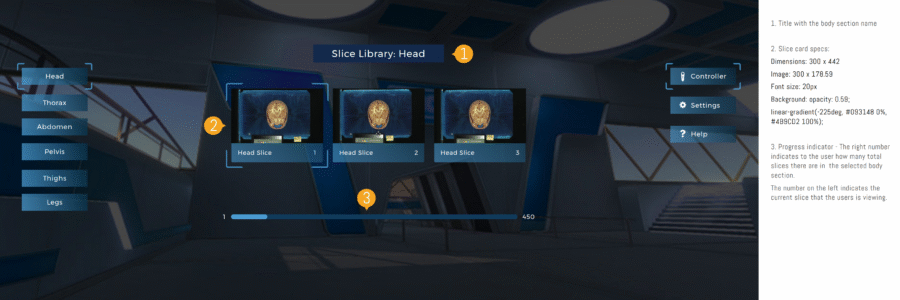
Once the interaction patterns and experience structure were finalized, I designed visual interfaces and supporting assets for development implementation.
My Team:
- Chris Haire (CXO/Interactions Lead | Bldg-25)
- Clint Little (Development Director | Bldg-25)
Outcome
The final experience provided students with a more approachable way to explore complex anatomical data through immersive VR interactions and intuitive navigation patterns. By simplifying controller interactions and prioritizing usability, the project helped create a learning experience that balanced educational depth with accessibility for non-technical users.
The project also provided valuable experience designing for emerging technologies and reinforced the importance of usability, interaction simplicity, and information hierarchy within immersive environments.
Tools
Oculus Rift • Sketch • Prototyping Tools • Adobe Creative Suite